
Documentary || From Waste to Resource : The Fashion Revolution by CeraV
- ceravfashion
- Jun 29, 2023
- 5 min read

The Fashion Waste Crisis & Our Solution Thereof
MAPPING THE WASTE PRODUCED BY THE FASHION INDUSTRY
The Value Chain of The Fashion Industry

The fashion industry encompasses a value chain that includes sourcing, manufacturing, distribution, marketing, consumption, circularity, and disposal. Each stage of the chain is interchangeably related.
The sourcing stage involves procuring raw materials for fashion production. Ethical sourcing practices and the use of sustainable materials are essential. According to the Ellen MacArthur Foundation, the fashion industry consumes 98 million tons of non-renewable resources annually (Ellen MacArthur Foundation, 2017).
Manufacturing involves the actual production of fashion products. This stage includes processes such as cutting, sewing, assembling, and finishing garments or accessories. The World Bank estimates that 20% of global water pollution comes from textile treatment and dyeing (World Bank, 2019).
After production, the fashion products must be transported to distribution centers or retail stores. Distribution involves coordinating and managing the movement of goods from manufacturers to retailers or directly to consumers. The fashion industry is responsible for 10% of global carbon emissions, with transportation contributing a significant portion (United Nations Environment Programme, 2018).
The next stage is marketing, where fashion brands invest in marketing and promotional activities to generate demand, which influences consumer behavior and trends. Encouraging sustainable consumption is crucial. The fashion industry produces 92 million tons of textile waste annually, equivalent to one garbage truck of textiles wasted every second (McKinsey & Company, 2020).
In the consumption stage, responsible consumer choices can make a difference. Extending the life of garments by just nine months can reduce their environmental impact by 20–30% (Wrap UK, 2017).
Circularity, promoting recycling and reuse, is gaining importance. Only 1% of textile waste is currently recycled into new garments (Ellen MacArthur Foundation, 2017).
Proper disposal practices are crucial to minimizing the environmental impact. In the U.S., 84% of unwanted clothes end up in landfills or incinerators (U.S. Environmental Protection Agency, 2018).
By addressing each stage of the value chain with sustainability in mind, the fashion industry can significantly reduce its environmental and social footprint.
OVERVIEW OF THE FASHION WASTE
Fashion waste encompasses discarded textiles and garments from production and consumption. It includes pre- and post-consumer waste and production waste like cutting scraps and rejected items. Fast fashion has exacerbated consumer waste due to its disposable nature. This waste contributes to environmental pollution and resource depletion.
The Textile Industry / Fast Fashion model

The textile industry refers to the production of fabrics, fibers, and materials used in the manufacturing of various textile products. Textile products include clothing and apparel; home textiles; technical textiles; fashion accessories; sports and outdoor textiles; industrial textiles; upholstery; and drapery. It encompasses a wide range of activities, including the cultivation of natural fibers (such as cotton and wool), the creation of synthetic fibers (such as polyester and nylon), and the production of textiles through processes like weaving, knitting, and dyeing.
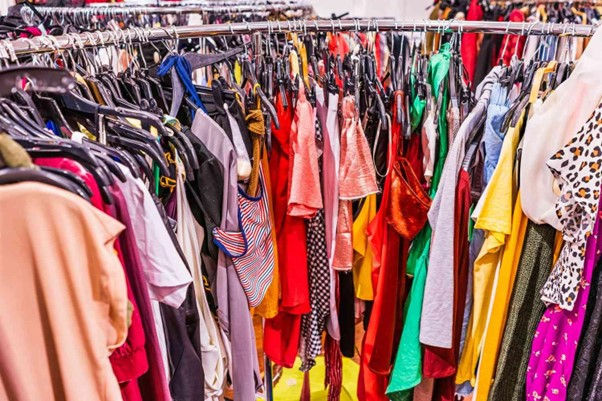
The fast fashion model, which is gradually becoming the center of the textile industry, is a specific business strategy employed by many companies in the textile industry. It emphasizes speed and affordability, allowing consumers to purchase trendy garments at low prices. This model is mainly characterized by rapid, low-cost, short product life cycles, and high-volume production.
Environmental Impact of the fast fashion model
The fast fashion model has significant environmental impacts throughout its lifecycle, from production to disposal. Fast fashion encourages consumers to constantly buy new clothes due to the rapid turnover of styles. This leads to overconsumption and the accumulation of large quantities of clothing. Many of these garments are discarded after only a few uses or end up in the back of closets, contributing to the waste problem. According to the Ellen MacArthur Foundation, the equivalent of one garbage truck of textiles is landfilled or burned every second globally. This waste includes garments that are discarded due to their low quality, short lifespan, or changing fashion trends.

In the United States alone, it is estimated that over 11 million tons of textiles end up in landfills each year, according to the Council for Textile Recycling. Synthetic fibers like polyester can take hundreds of years to decompose, while natural fibers like cotton may release methane, a potent greenhouse gas, as they break down in landfills.
Although good donation systems exist and opportunities for reselling and renting these clothes exist, they will one day still end up in our landfills.
The recycling rates for textiles, including fast-fashion items, are relatively low. The U.S. Environmental Protection Agency (EPA) estimates that only about 15% of all textiles were recovered for recycling in 2018, while the remaining 85% ended up in landfills. Similar challenges are observed in other parts of the world.
What has been done?
Fast fashion companies like H&M and Zara have implemented sustainability initiatives to reduce their environmental impact. H&M introduced the Conscious Collection with garments made from sustainable materials and set targets for 100% sustainably sourced materials by 2030. Zara has launched a garment recycling program and aims to use 100% sustainable fabrics by 2025. Despite their sustainability initiatives, these companies are still producing clothes at a rapid rate, with projections indicating a 50% increase in production within the next seven years. This continued growth poses challenges in terms of waste management and the impact on landfills, such as the alarming situation seen in places like Korle Lagoon, Accra, Ghana.
What needs to be done?
To address the environmental impact of the fast fashion model and promote a more sustainable and responsible approach to fashion, what the world needs now is to take out the billions of clothes in our landfills and channel them to another industry. This can be done by altering the garments, combining them with other materials, or using them as raw materials. More specifically, an area of opportunity in this field is textile-to-fiber recycling for other industries. Recovered textile fibers can be used in various industries beyond fashion. For example, they can be transformed into insulation materials for construction, filling for furniture or mattresses, or even in automotive or industrial applications. By finding new uses for these fibers, we can create a circular economy and reduce waste.
What we do!
At CeraV, our mission is to completely remove textile waste and promote sustainable fashion through innovative recycling and upcycling techniques. Fashion waste, which is a major problem in the fashion industry, will no longer be a problem but also the solution and a game-changer for our planet's environmental issues. Our current focus is on manufacturing durable, eco-friendly tiles from unwanted clothing, which will revolutionize the world of sustainable fashion.

By utilizing our cement tiles made from shredded clothes, we not only address fashion waste but also significantly reduce the use of traditional cement in their production. Cement is a material that greatly contributes to carbon emissions worldwide. By reducing the use of cement, we can effectively decrease carbon emissions in the atmosphere and completely eliminate clothing waste. Our innovative approach not only tackles the environmental impact of fashion but also helps mitigate the carbon footprint associated with cement production.
CeraV's cement tiles have an additional positive impact on the construction industry and infrastructural development, particularly in Africa. By providing cheaper and more durable tiles, we contribute to cost-effective construction solutions. This affordability enables improved infrastructural development, allowing for the creation of sustainable and resilient structures across the continent.

This synergy allows us to address interconnected issues simultaneously, creating a positive impact on our environment, improving the construction industry, and paving the way for a more sustainable future with enhanced infrastructural development beginning in Africa. By doing so, we aim to not only minimize textile waste but also inspire a paradigm shift in the industry.
References:
Ellen MacArthur Foundation. (2017). A New Textiles Economy: Redesigning Fashion's Future.
McKinsey & Company. (2020). Style that’s sustainable: A new fast fashion formula.
U.S. Environmental Protection Agency. (2018). Advancing Sustainable Materials Management: Facts and Figures 2017.
United Nations Environment Programme. (2018). UN Alliance for Sustainable Fashion: Facts and Figures on Sustainability and the Environment in the Fashion Industry.
World Bank. (2019). What a Waste 2.0: A Global Snapshot of Solid Waste Management to 2050.
Wrap UK. (2017). Valuing Our Clothes: The Cost of UK Fashion.
Comments